Cattle Body Condition Scoring: How to Use BCS Records to Improve Reproductive Performance
Cattle body condition scoring (BCS) is a free management tool most producers underuse. This guide explains how to score, when to record BCS, and how to use.
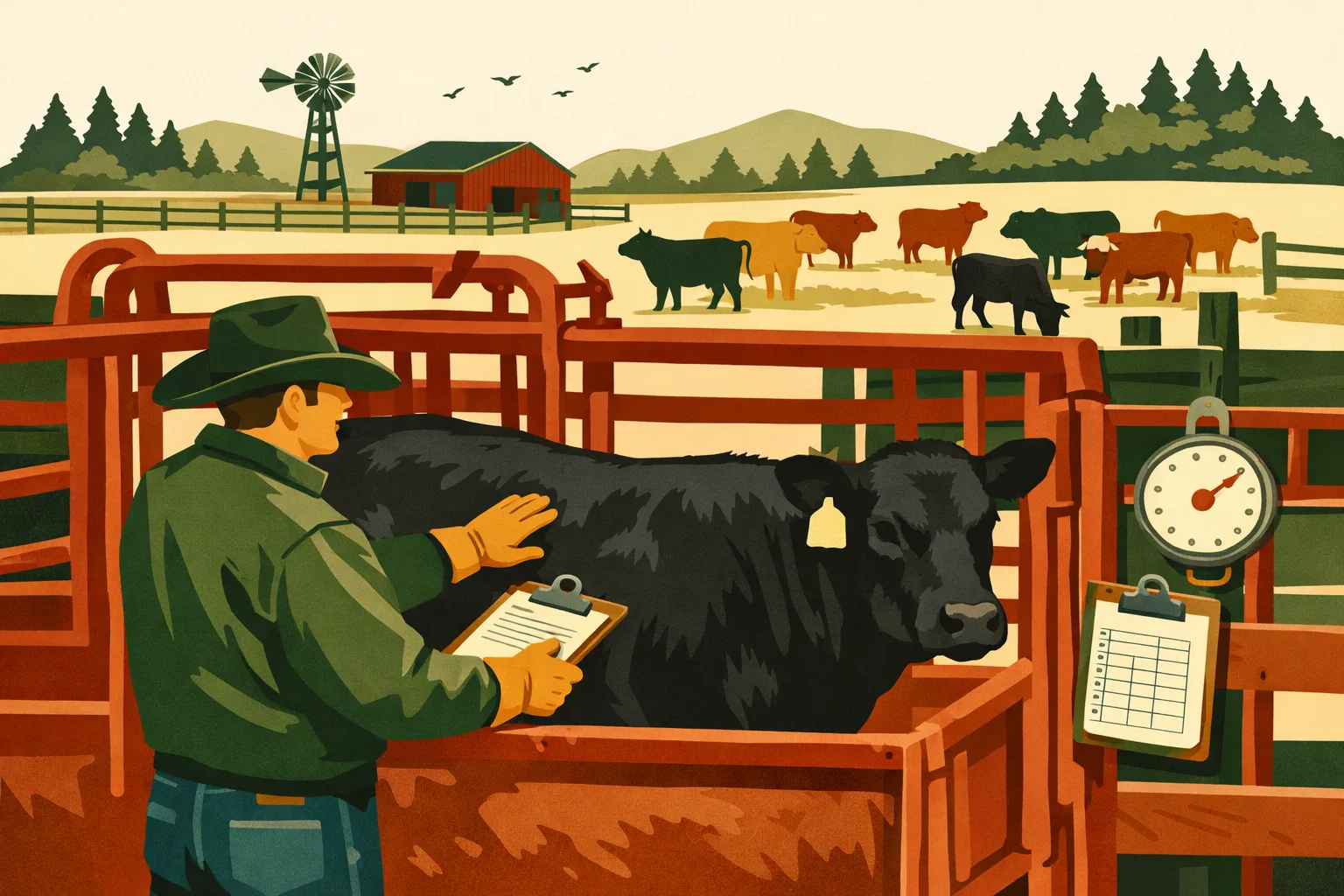
A cow that calves too thin has already made her breeding decision for you — three months before the bulls go out. She will cycle late, breed late, wean a lighter calf next year, and eventually fall out of the herd as an “open cow” for reasons that had nothing to do with fertility and everything to do with energy balance eight months earlier. Body condition scoring is the only cheap, repeatable measurement that lets you see that outcome coming while you can still change it. The scoring itself takes seconds. The value comes from writing it down, doing it on a schedule, and reading the trend across the herd.
Why BCS Beats Weight for Reproductive Decisions
Scale weight is a mix of frame, gut fill, fetus, and fat. A 1,250 lb cow can be a big-framed thin cow or a moderate-framed fat cow, and those two animals need opposite feeding programs. Body condition score isolates the piece you can actually manage: stored energy reserves.
Reproduction sits at the bottom of the cow’s priority list. Her body funds maintenance first, then growth, then lactation, then — last — cycling and conception. When energy is short, she quietly shuts down reproduction long before she looks obviously starved. That’s why BCS at calving is one of the strongest predictors of whether a cow breeds back inside a 60- to 65-day breeding window.
The mechanism is the postpartum interval — the number of days from calving until a cow resumes normal estrous cycles. Cows calving in thin condition routinely run 20 to 40 days longer postpartum intervals than cows calving in moderate condition. On a 365-day calving interval target, a cow only has about 80 to 85 days after calving to conceive again. Burn 30 of those days on anestrus and she’s either late or open.
Downstream effects that show up in your records:
- Colostrum quality and volume — thin cows produce less, and calves absorb less immunoglobulin, which shows up as higher scours and pneumonia treatment rates
- Calf vigor at birth — slower to stand, slower to nurse, more assist calls in cold weather
- Weaning weight — thin cows milk less through the first 90 days
- Culling pressure — a herd that calves thin generates more opens, which forces you to keep replacement rates high
The 1-9 Scale, Decoded
North American beef herds almost universally use the 1-to-9 scale. UK, Irish, Australian, and New Zealand operations, and most dairy programs, use a 1-to-5 scale with quarter-point increments. Pick one, write it in your protocol, and never mix them in the same record set. A “3” means emaciated on one scale and ideal on the other — that mistake corrupts years of data.
Thin: BCS 1-3
Ribs, spine, hooks, and pins all visible with no fat cover. The tailhead is sunken with a visible cavity on either side. No brisket fat, no fat in the flank. These cows are in negative energy balance and reproductively shut down or close to it. A BCS 3 cow at calving will almost never breed back on time without intervention.
Borderline to Ideal: BCS 4-6
This is where nearly all your management decisions live.
- BCS 4 — last two or three ribs still visible, spine noticeable, some fat over the hooks. Functional but with no reserve. A wet spring or a hard winter drops her to a 3 fast.
- BCS 5 — ribs not visible without pressing, spine smooth, tailhead full but not padded. The minimum acceptable calving score for a mature cow.
- BCS 6 — smooth appearance throughout, ribs require firm pressure to feel, fat starting to fill the tailhead area and brisket. The target for first-calf heifers and second-calvers.
Fleshy to Fat: BCS 7-9
Fat deposits are obvious over the ribs, brisket, tailhead, and around the vulva. Reproduction usually stays fine through BCS 7, but you’re paying for stored feed the cow doesn’t need, and BCS 8-9 cows carry higher calving difficulty and heat stress risk. Consistently fat mature cows are a signal your feeding program is oversupplying a group that should be sorted off.
BCS Reference Table
| BCS (1-9) | Equivalent (1-5) | Ribs | Tailhead / hooks | Backfat feel | Typical reproductive outcome at calving |
|---|---|---|---|---|---|
| 2 | 1.0-1.5 | All visible, sharp | Deep cavity, bones sharp | None | Prolonged anestrus; very poor rebreeding |
| 3 | 2.0 | 5+ visible | Cavity present, hooks sharp | None | Late cycling; low first-service conception |
| 4 | 2.5 | 2-3 visible | Slight cavity, hooks rounded | Trace | Marginal; late breeders common |
| 5 | 3.0 | Not visible, easily felt | Smooth, no cavity | Thin, even | Acceptable — mature cow minimum |
| 6 | 3.5 | Firm pressure to feel | Fully filled, soft | Moderate | Strong rebreeding; target for heifers |
| 7 | 4.0 | Difficult to feel | Fat pads visible | Thick | Good rebreeding; feed cost above need |
| 8-9 | 4.5-5.0 | Cannot feel | Prominent fat, brisket full | Heavy | Dystocia and heat stress risk rises |
Hair coat and gut fill mislead the eye. A cow in full winter hair after a big meal can look one full score better than she is. This is why you score with your hands whenever cattle are restrained, and why you standardize scoring conditions when you’re scoring in the pasture.
The 9 Scoring Checkpoints, In Order
Work the same anatomical checkpoints in the same order every single time. Consistency between scorers matters more than absolute precision — a herd scored one-half point optimistically but consistently still produces usable trend data.
- Brisket — fat fill in front of the chest floor. Fills in at BCS 6 and above; flat and hard at 4 and below.
- Shoulder / point of shoulder — angularity here shows early condition loss.
- Ribs (last 3-5) — the primary visual gate. Visible at 4 and below, felt but not seen at 5, requiring pressure at 6+.
- Backbone / spine — run a flat hand down the topline. Individual vertebrae distinguishable means 4 or lower.
- Loin edge / transverse processes — the short ribs. Sharp edges point to a thin cow even when hair hides the ribcage.
- Hooks (hip bones) — rounded versus sharp is a fast field cue at a distance.
- Pins — bone prominence and the presence of fat between pins and tailhead.
- Tailhead depression — the single most reliable single-point cue. Cavity = thin. Level = moderate. Padded = fleshy.
- Flank / udder fill in the escutcheon — fat deposits in the flank and around the udder attachment confirm BCS 6+.
Score to the whole point in the field, or to the half point if your team is trained and calibrated. Half points that aren’t repeatable are worse than whole points that are.
Getting Two People to Agree
Scorer drift is the number one reason BCS records lose value. Fix it with a 30-minute calibration session twice a year:
- Pull 10 cows across the range of the herd through the chute
- Have every scorer record independently on paper — no discussion
- Compare, discuss the outliers, physically palpate together
- Repeat until scorers agree within a half point on 8 of 10
Record who scored in the animal record. When you review trend data later and see a herd-wide half-point jump that lines up with a change in scorer, you’ll know it’s an artifact, not a nutrition event.
When to Score: Five Calendar Points That Drive Decisions
Scoring “whenever we think of it” produces data you can’t act on. Tie scoring to points where you can still change the outcome.
1. Weaning (roughly 90-120 days before calving)
The single highest-leverage score of the year. The cow is dry, her nutrient requirements are at their annual minimum, and you have three to four months of cheap feed conversion in front of you. Adding condition on a dry, mid-gestation cow costs a fraction of what it costs on a lactating cow.
At weaning, sort into three groups based on score:
- BCS 3-4: needs to gain 1-2 full scores — high-energy group
- BCS 5: maintain
- BCS 6+: hold or let drift down slightly to conserve feed
2. 60 Days Pre-Calving
Your last realistic window to fix condition. Fetal growth accelerates in the final trimester, so gains get more expensive from here, but a half-point recovery is still achievable. Re-score and adjust the thin group’s ration.
3. At Calving
This is the score that predicts rebreeding. Record it at the same time you record calving ease, calf sex, birth weight, and vigor. This one field ties your nutrition program directly to your reproductive results and eventually gives you your herd’s own calving-BCS-to-conception relationship rather than a textbook one.
4. Start of Breeding Season
Cows lose condition during early lactation almost regardless of what you feed. What matters is the direction: a cow at BCS 4 and gaining will often cycle, while a cow at BCS 5 and dropping fast may not. A start-of-breeding score plus the calving score gives you that slope.
5. Pregnancy Check
Score every cow as she comes through for preg check. Now you can cross-tab open status against calving BCS and produce the most useful management report on the ranch: what score did my open cows calve at?
Reading the Trend, Not the Snapshot
A single score is a data point. Four scores across a production year is a management tool.
BCS slope between events is what you’re really after:
- Weaning → calving should be flat or slightly positive. A negative slope here means your winter program is underfeeding the herd, and you’ll pay for it at breeding.
- Calving → breeding will be negative for most cows. Losing more than one full score in that window is a warning flag.
- Breeding → weaning should be positive as grass improves and milk demand falls. Cows that don’t recover here are candidates for a closer look at age, dentition, or parasite load.
Herd distribution matters more than herd average. A herd averaging BCS 5.0 could be all fives, or it could be half threes and half sevens. The second herd has a serious problem — the thin half won’t breed and the fat half wasted feed. Look at the histogram, not the mean. A healthy calving distribution is roughly 80% or more at BCS 5-6, with fewer than 10% at 4 or below.
Individual outliers are cull candidates in disguise. A cow that consistently scores a full point below herdmates on identical feed is telling you something: age, bad mouth, chronic parasites, a hard-milking phenotype she can’t support, or lameness. Two or three years of BCS records make that pattern obvious in a way that memory never will.
What Condition Actually Costs
Feed math varies by region, ration, and cattle type, and you should confirm any specific plan with a nutritionist. But the planning rules of thumb are worth having in your head.
For a mature beef cow of roughly 1,200 lb, one BCS unit represents somewhere in the neighborhood of 75-80 lb of body weight. To move a cow from BCS 4 to BCS 5, you’re targeting about that much gain, plus enough energy to cover fetal growth if she’s pregnant.
A worked example, using placeholder prices you should swap for your own:
| Scenario | Days available | Target gain | Extra supplement | Approx. feed cost/head |
|---|---|---|---|---|
| Score at weaning, fix over winter | 100 | 80 lb (1 BCS) | ~3 lb/day | ~300 lb — modest |
| Score at 60 days pre-calving | 60 | 80 lb (1 BCS) | ~5 lb/day | ~300 lb, higher energy density needed |
| Discover it at calving | 0 useful days | Cannot recover pre-breeding | n/a | Cost shows up as an open cow |
The point isn’t the exact dollar figure — it’s the shape of the curve. The same body condition unit costs meaningfully less when you buy it at weaning than when you buy it at 60 days pre-calving, and it becomes essentially unbuyable once lactation starts. An open cow’s cost is a full year of maintenance plus a lost calf, which dwarfs any supplement bill.
Sorting matters here too. Feeding the whole herd to bring the bottom 20% up to score means overfeeding the top 60%. If you can build a thin-cow pen and feed differentially for 60-90 days, you capture most of the reproductive benefit at a fraction of the feed cost. That sorting decision is only possible if you have individual scores recorded — a herd average won’t tell you who to pull.
First-Calf Heifers Deserve Their Own Target
Two-year-olds are still growing while lactating and rebreeding. They have the highest nutrient requirements and the least fat reserve in the herd, and they are consistently the group most likely to come up open.
Practical adjustments:
- Target BCS 6 at calving, not 5
- Calve them 2-3 weeks ahead of the mature cows to buy extra postpartum recovery days
- Score them separately and report them separately — mixing them into the herd average hides their problem
- Score again at 30 days post-calving; heifers that dropped a full point in a month need intervention immediately
- Consider a shorter breeding window for heifers so that early-conceiving genetics propagate
Second-calvers deserve similar scrutiny. A heifer that just barely bred back as a two-year-old often shows up thin as a three-year-old, and that’s where a lot of herds silently lose their best young genetics.
A 20-Minute Scoring Session: Practical Checklist
You do not need a chute to score. You need consistent conditions and a system.
Before you start
- Confirm which scale you’re using (1-9 or 1-5) and that everyone scoring knows it
- Run the 10-cow calibration check if it’s been more than six months
- Score at a consistent time relative to feeding — ideally before the morning feed, not after
- Have ear tag numbers readable; score is worthless without animal ID
- Note hair coat and mud status if either is extreme
During scoring
- Work the same nine checkpoints in the same order on every animal
- Palpate ribs and tailhead by hand whenever cattle are restrained
- View the cow from behind and from the side — the side view exaggerates flesh, the rear view exposes hooks and pins
- Record to the whole or half point per your protocol, no finer
- Flag any cow more than one point off her last score for a closer look
- Note lameness, bad eyes, poor teeth, or udder issues while you’re already looking
After scoring
- Enter scores the same day — memory decays fast and paper tickets get lost
- Build the distribution, not just the average
- Sort thin cows into a management group with a written feeding plan and an end date
- Set a calendar reminder for the next scoring event
- Compare against the same event last year
Time budget: roughly 3-5 seconds per head chute-side, or 20-30 minutes for 50 cows scored visually in a pen or on pasture. Data entry adds another 10-15 minutes on paper, or effectively zero if you’re entering scores on your phone as you go.
Common Mistakes That Ruin BCS Data
Scoring from the truck at 40 yards. Distance scoring compresses everything toward the middle. You’ll miss the thin cows, which are exactly the ones you need to find.
Letting hair coat fool you. A heavy winter coat can hide a full score of condition loss. If you can’t touch the animals, be deliberately pessimistic in mid-winter and confirm at the next handling.
Scoring once a year. A single score has no slope. Two scores per production year is the practical minimum; four is where the data starts driving decisions.
Recording scores in a notebook that lives in the truck. Scores that never make it into a searchable record can’t be cross-referenced against calving or preg-check results, which is where all the value is.
Averaging the herd and stopping. The average hides the distribution, and the distribution is the actionable part.
Changing scale or scorer without noting it. Every scale or personnel change should be recorded so future you doesn’t misread an artifact as a nutrition event.
Ignoring the fat tail. Cows at BCS 7-8 in a herd that’s otherwise fives are eating feed they don’t need. That’s real money, and it’s usually a sorting problem, not a genetics problem.
The Record Fields Worth Capturing
Minimum viable BCS record:
- Animal ID
- Date
- Score and scale used
- Event context (weaning / pre-calving / calving / breeding / preg check)
- Scorer initials
- Method (chute-side palpation vs. visual)
Fields that multiply the value when you have them:
- Days in milk or days postpartum
- Parity / age
- Current management group or pasture
- Last calving date and calving ease score
- Preg status and estimated gestation stage
- Weight, if you’re weighing anyway
- Free-text note for lameness, teeth, udder, or temperament observations
With those fields in place you can answer the questions that actually change profitability: What score did my open cows calve at? Do my three-year-olds recover condition slower than my mature cows? Did the thin-cow group I supplemented last winter breed back on schedule? Which pasture group loses the most condition between calving and breeding?
Adapting the Approach for Sheep, Goats, and Hogs
The principle transfers; the anatomy doesn’t. Small ruminants use a 1-5 scale scored primarily by palpating the lumbar vertebrae — the spinous and transverse processes just behind the last rib — because wool and hair make visual scoring unreliable. Target BCS 3.0-3.5 at breeding and lambing/kidding, with ewes and does carrying multiples needing the upper end. Score at breeding, mid-gestation, and weaning at minimum.
Sows are typically scored on a 1-5 scale with backfat measurement as the more precise alternative, targeting condition at farrowing that supports lactation without excess. The record structure — animal ID, date, score, event context, scorer — stays identical regardless of species, which is exactly why a single herd record system should handle all of them.
How HerdFlo Helps
BCS is a discipline problem, not a knowledge problem. Most producers can eyeball a thin cow. What they can’t do from memory is tell you that cow number 447 has dropped a half point at every calving for three straight years, or that 22% of